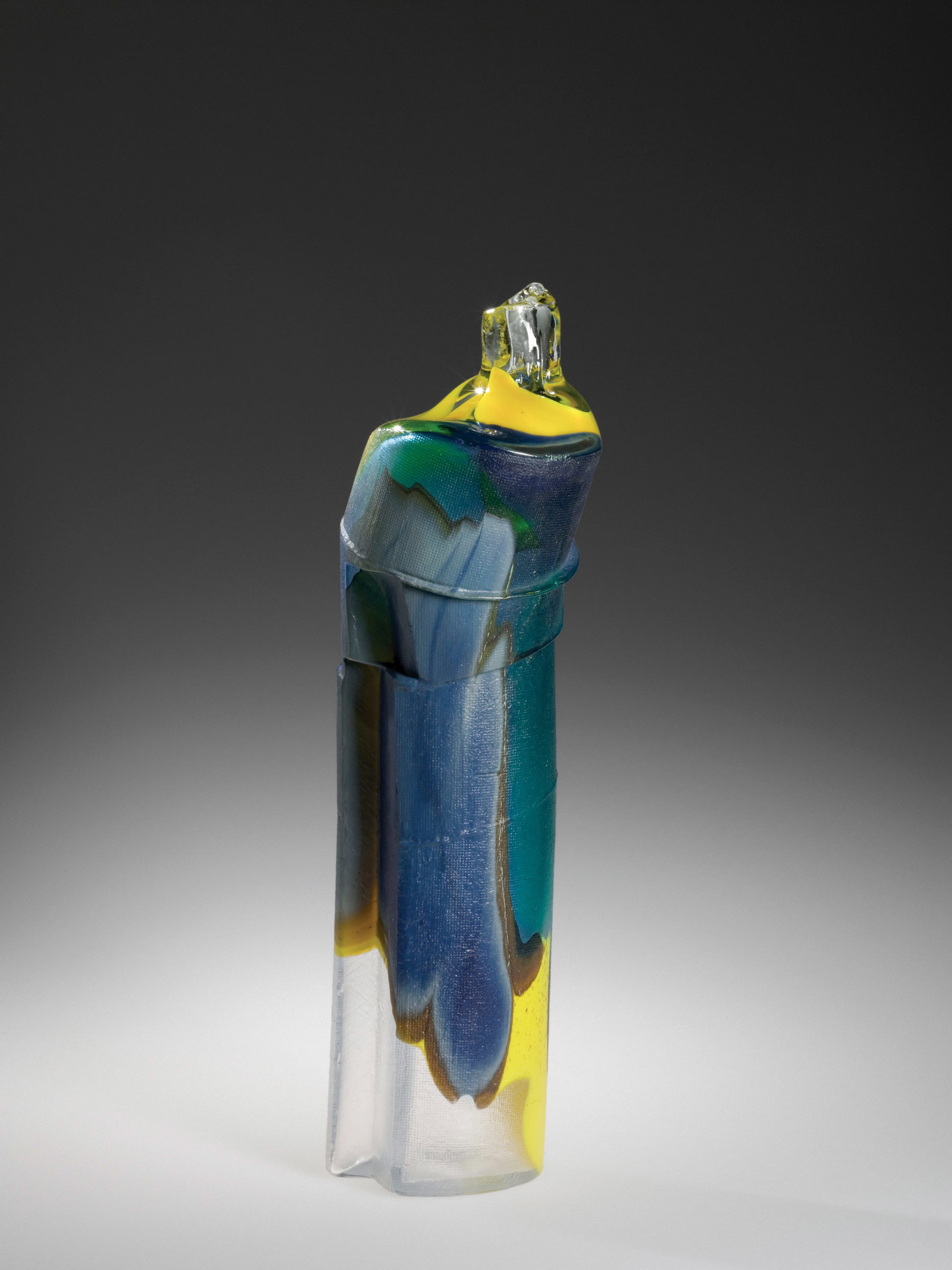
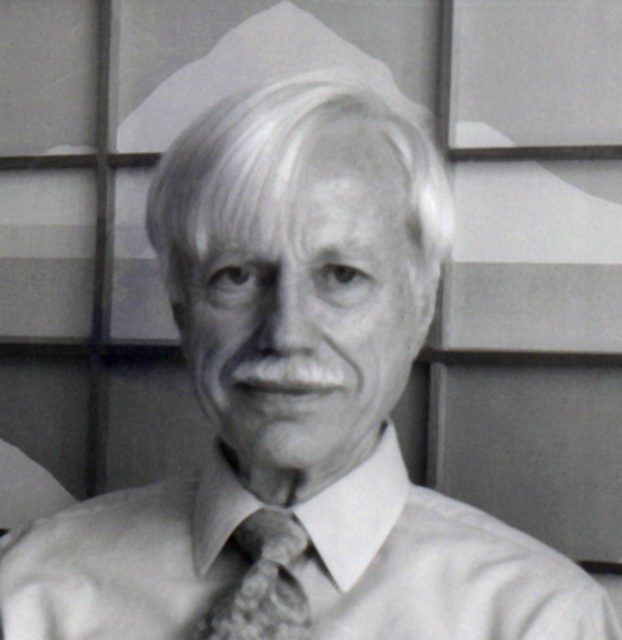
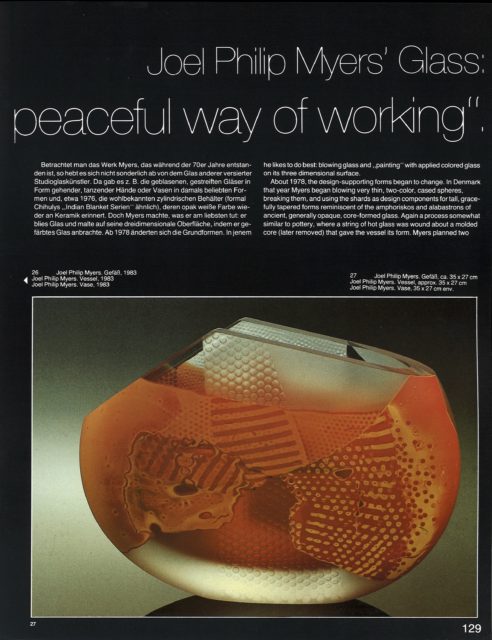
In a 1983 interview with Paul Hollister Joel Philip Myers discusses the use of glue in his pieces, being of the older generation of glass artists, preconceived notions in glassmaking and positivity in his work. Interview with Joel Philip Myers by Paul Hollister, June 11, 1983 (Rakow title: Joel Philip Myers interview [sound recording] / with Paul Hollister, BIB ID: 168435) Clip length: 04:41.
Time stamp: 00:00
Clip 1: Joel Philip Myers discusses gluing in his work.. Clip length: 01:50.
JPM: It creates a dimensional effect, okay? I guess my—
PH: Yeah.
JPM: —my reaction is the extension. There are things that happen—
PH: Oh yeah.
JPM: You know, there are things that—I’m finished with the piece and I could say, and I say to myself, ‘Gee, if I—in this area it needs something—’
PH: Mm-hmm.
JPM: ‘—I’m going to select the right color, the right formula—’
PH: Mm-hmm.
JPM: ‘—I’m going to put this thing right here, and I—you know—I don’t maybe make an effort to hide it. I don’t make any effort to hide it. But I would guarantee you that if you were to look at that piece, you’d never know the difference.
PH: No.
JPM: And you would—and you would never know the difference. And considering that the minimal amount of gluing involved, in terms of it—you know, of its permanence, it’ll be permanent, because there’s so little surface contact, so little influence of that—that process on the piece. Just like saying I need something right here, you know, so you take—and I glue just the right thing on there, and I can guarantee you, you wouldn’t know—I’ve had people—if you would pick it up, and if you didn’t know it was glued, you wouldn’t know it was glued. And then, as a matter of fact, what I’ve also done is—this is another thing. I’ve colored the glue. Colored the glue, and then used the shards on top of it, without any—and I’d have it spill out. And I wouldn’t—to me, it’s a beautiful extension of the idea, because all the shards spill out, and they leave a—a halo of color around the edge.
PH: The bubbly—
JPM: No no, it’s not bubbly, it’ll just be—it would be—it would just be—
PH: Oh, I see, just the shiny—
JPM: Just the little shiny area of color around it.
PH: Mm-hmm.
JPM: And the shard would be in the center and, you know, this is quite; we’re not talking about anything like that—we’re talking quite, quite close to the surface.
PH: Yeah, an eight of an inch.
Time stamp: 01:53
Clip 2: Joel Philip Myers talks about being of the older generation of glass artists. Clip length: 01:00.
Joel Philip Myers [JPM]: And the thing is that I—what I’m sensitive to, what I’m sensitive to the fact that I’m one of the—one of the older people, I’m one of the veterans in the glass field. And as such, I’m very sensitive to the fact that I could very well be—I mean, I think that when you think of a veteran in any field, you may think of somebody that has begun to be limited creatively in their output. And I see students doing a lot of things that I would question. And I wonder whether my own conservatism, and my own, my own generation gap, contributes to that conservative attitude and prevents me from doing things that maybe are worthwhile trying and seeing how they work. And so I’m really sensitive to that.
Time stamp: 02:55
Clip 3: Joel Philip Myers talks about preconceived notions in glassmaking and positivity in his work. Clip length: 01:45.
Joel Philip Myers [JPM]: There’s an attitude that some people have about working, that sort of crosses out and eliminates a lot of the preconceived notions about things that all of us—or a lot of us—are hung up at. You know, we’re all hung up in some of these preconceived notions [PH starts speaking over JPM] of what you can do and what you can’t do.
Paul Hollister [PH]: You’re right, we are.
JPM: So, for that reason, I always see myself—
PH: But you’re so tentative about this. I mean, you’re—I know you’re cautious—
JPM: Yeah, I’m very cautious.
PH: —a careful worker, and everything anyway, and you’re so tentative about this that you’re never going to jump into the pool. You’re—I look at you and you’re all knucklebound—[JPM laughs]
JPM: [inaudible]
PH: Well, you know, it’s all one piece.
JPM: It’s all one piece, yes.
PH: And—
JPM: And another thing, too, is that I think that—one of the kind of feeling that thing about my work which I think is relevant, and I think is good, is the fact that I think that—I hope in some ways, is the fact there’s a kind of real joy about the work, something about exuberance about the work, and my feeling about color particularly, how all that—that works create a kind of image of—a very positive image about how I feel in my life. I’m not—it’s not that I’m very, you know, heavy and dark—
Permalink