Pidgeon Pie
Pie “coffins”
In the sixteenth and seventeenth centuries pie crusts were almost unrecognizable from the buttery pastry used today. Thick, stiff, and almost inedible, these crusts were called “coffins” and acted as containers for pie filling. Coffins were important in the baking process to keep the meat moist, and juices contained as well as key to preserving food. When airtight coffins could preserve the filling for several days. Coffins were not meant to be eaten, although it is likely that they were consumed by servants or the poor.

Circle of Jacob van Es, Still life with meat pies, a roast fowl, olives, capers, and strawberries in blue and white porcelain bowls, a tazza with grapes, a roemer filled with wine, a ceramic jug and other items, all on a wood table, 17th century. Oil on panel. By Circle of Jacob van Es - Sotheby’s, Sale N08952 (New York, 2013-01-31–2013-02-01), Public Domain, https://commons.wikimedia.org/w/index.php?curid=24349937.
The simplest coffins were made from four, water, and a fat like butter, lard, or suet. Later coffin recipes called for eggs and spices, like saffron. In his household manual published in 1615, Countrey Contentments, or, The English Huswife, Gervais Markham recommended using rye flour for “standing dishes'' that “must be kept long.” The rye flower made the coffin “moist, thick, tough, course, and long lasting.” Markham specifically recommended a rye-based coffin for pies made of venison, wild boar, swan, and elk.1 The rye flower was kneaded with hot water and a little butter to create a deep coffin, stiff enough to withstand baking and sitting for an extended period.2
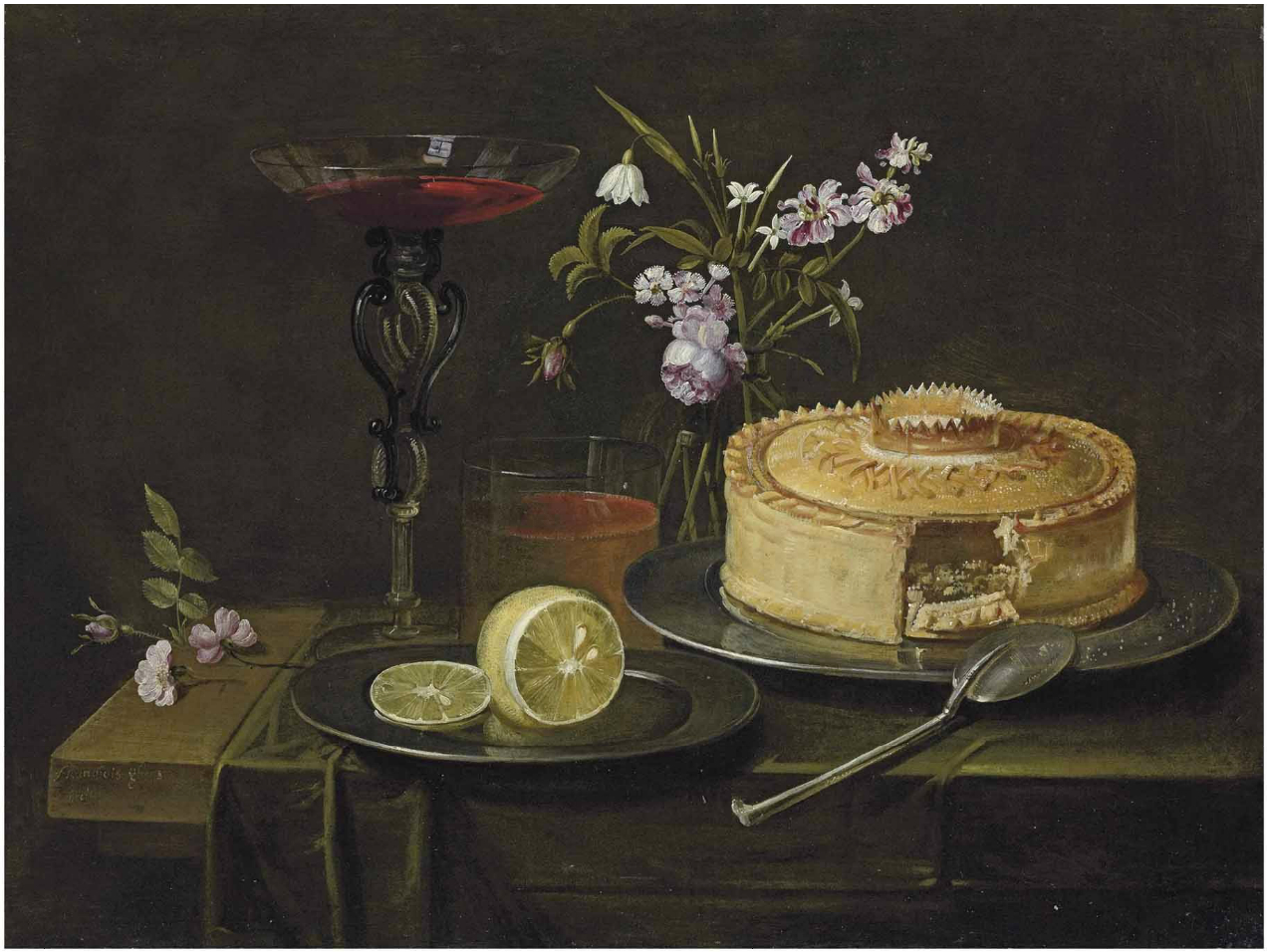
Frans Ykens, A pie and a cut lemon on pewter platters, a façon-de-Venise wine glass and flowers in a glass vase, on a partly-draped table, between 1615 and 1692. Oil on copper. By Frans Ykens -http://www.christies.com/lotfinder/paintings/frans-ykens-grapes-peaches-a-fig-and-5586311-details.aspx, Public Domain, https://commons.wikimedia.org/w/index.php?curid=46628799.
For pies that would be eaten more quickly, like turkey, capon, pheasant, and lamb, Markham recommended a “good white crust” only “somewhat thick.” This crust was made from wheat and butter with sugar and rosewater added for sweetness.3
Coffins were also used to entertain banquet guests. They provided additional ornamentation to the table through their intricate shaping and decoration, often designed to complement the fillings. Pies could also be filled with unexpected and exciting contents. Instead of a traditional cooked filling a coffin could be stuffed with live animals or birds that would burst out when cut.
1Markham, Countrey Contentments,95.
2Ibid.
3Ibid.